






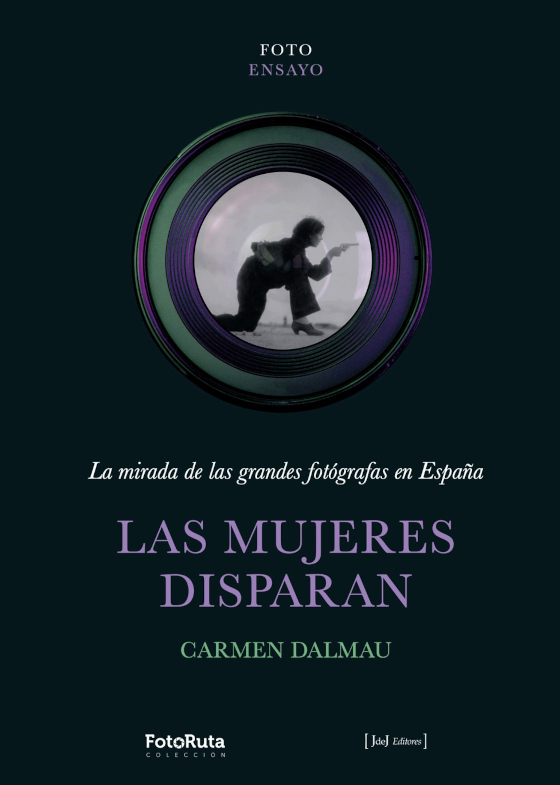
Las mujeres disparan. La mirada de las grandes fotógrafas en España
Carmen Dalmau
FotoRuta
An essay by Carmen Dalmau that celebrates the history, presence, and talent of women photographers in Spain.
The book, part of the FotoRuta collection in its Photo Essay series, features a foreword by Mónica Carabias Álvaro, director of the National Center for Photography.
This is Carmen Dalmau's second book, and its purpose is clear: to highlight the continuous and decisive presence of women photographers in the history of photography in Spain, from the medium's beginnings to the present day. Through a rigorous yet accessible narrative approach, the book shows how these creators have not worked in isolation, but rather in harmony with their counterparts in other artistic movements, both national and international.
Divided into ten chapters structured around key chronological periods and historical turning points, *Women Shoot* takes a journey that goes beyond individual biographies to offer a contextualized, critical, and enriching perspective.
Each chapter presents thirty photographers, selected for their diverse approaches, visual languages, and contexts, serving as a representation of many others whose work has been equally significant.
The first two chapters—"The Inhabited Gaze" and "The First to Shoot"—offer a theoretical and contextual framework that allows us to understand how women photographers have gradually become part of the visual landscape, in constant dialogue with other artistic disciplines developed by women.
The third chapter delves into the lives of pioneers like Amalia López Cabrera, who opened her studio in Jaén in 1860, and Sabina Muchart, active in Málaga from 1887. Both exemplify the many professionals who, from the very beginning, assumed an active and contemporary role in the evolution of photographic technique. Eulalia Abaitua, considered the first Basque photographer, is also highlighted as a role model for a generation of women who embraced photography as a form of artistic expression.
The fourth chapter addresses one of the most intense periods in recent history: the Spanish Civil War. Here, figures like Gerda Taro and Kati Horna stand out, capturing images from the front lines or the rear that have become a visual testament to the conflict. The chapter also includes the perspective of Inge Morath, who reflected the difficult postwar years in her photographs.
As the book progresses, it introduces figures who have built prestigious international careers, such as Cristina García Rodero, Cristina de Middel, Susana Vera, and Lua Ribeira. It also features photographers recognized with the National Photography Prize, such as Pilar Aymerich and Bárbara Allende (Ouka Leele). All of them stand out not only for the quality of their images but also because they represent unique and cross-cutting approaches within the contemporary visual landscape.
In the author's words, these thirty selected photographers—a number limited by the book's length—serve as a synthesis and archetype of many other women who have worked, and continue to work, with the power of the image in Spain. Women with original, critical perspectives, different from the hegemonic male gaze that has traditionally dominated the history of art and photography.
Women Shoot is not only a necessary recovery but also a reclaiming of the place that has always belonged to women photographers in the visual and cultural history of our country. A book that combines historical analysis with commitment, technical knowledge with aesthetic reflection, and that invites us to rethink photography from other perspectives.